Hoyo Azul Cenote Depth, Cave Facts, and Natural History
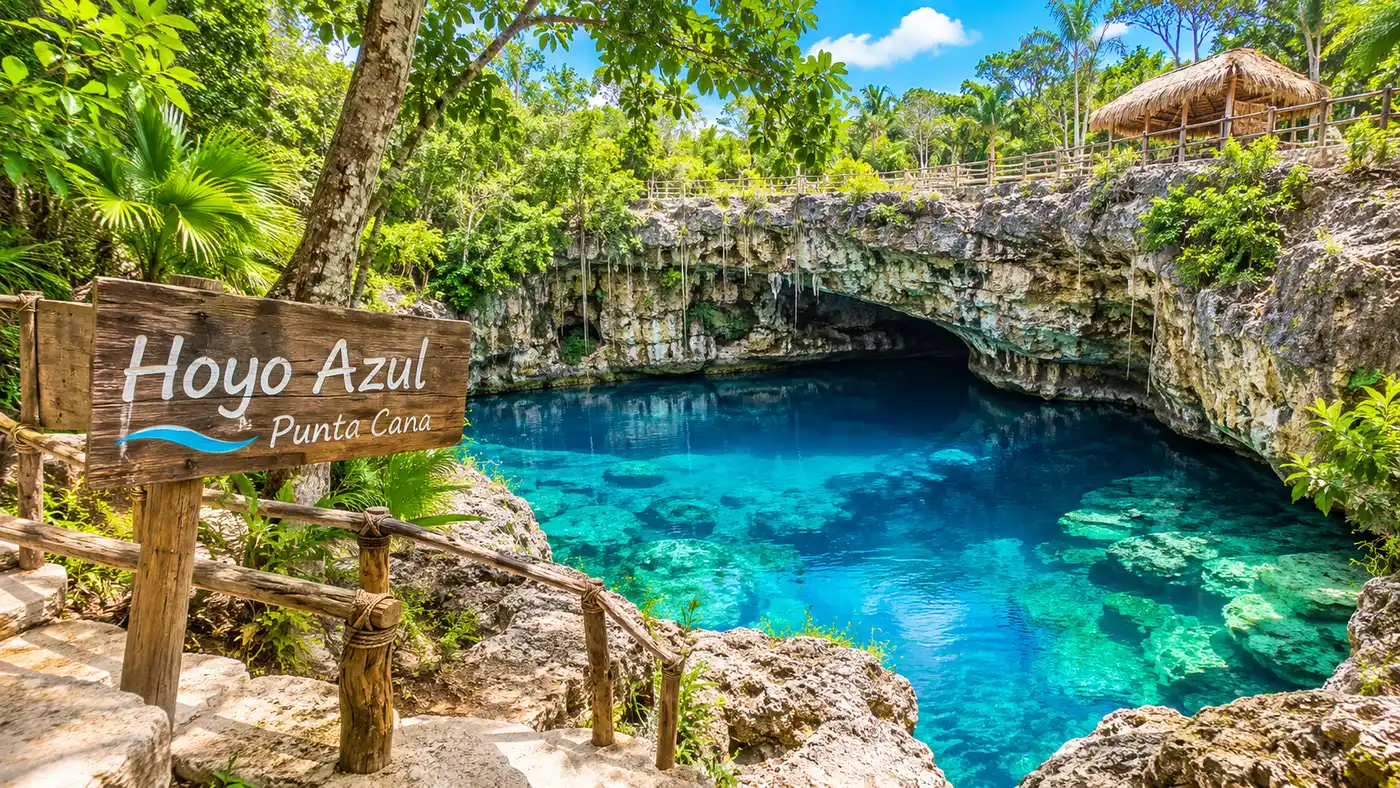
Standing on the wooden platform above the water, your eyes lie to you. You look down through liquid that looks like melted turquoise glass, spot a pale limestone boulder resting on the floor, and assume it sits waist-deep. Then someone leaps off the stairs and keeps sinking, their kicking legs shrinking into the blue abyss. Travelers constantly stand on the edge arguing about how deep is hoyo azul punta cana, simply because the clarity completely destroys any normal sense of perspective. It is disorienting, beautiful, and slightly chilling all at once.
The pool is hidden at the base of a sheer 75-meter cliff in the Cap Cana region, tucked away beneath humid tropical canopy. Most visitors know it as an excursion stop inside Scape Park, but long before ziplines and suspended walkways were bolted into the rock, this sinkhole lived a quiet life shaped by rainwater, tectonic shifts, and ancient ocean floors. Understanding how this sinkhole formed - along with the real measurements beneath the surface - turns an ordinary afternoon swim into an encounter with deep geological time.
Book your hoyo azul punta cana experience:
The Geological Mystery: How Deep Is Hoyo Azul Punta Cana Really?
The water level fluctuates slightly with seasonal rainfall, but at its deepest point, the pool plunges down roughly 14 meters. That is about 46 feet. In some shallower pockets along the back limestone wall, the floor slopes up to around 3 or 4 meters, which is still well over your head. If you drop a pair of sunglasses here, they do not just sit within reach. They drift down through several stories of cold water before settling into silt pockets between submerged boulders.
This dramatic hoyo azul punta cana depth surprises people because cenotes in Mexico often have dark, murky openings with visible drop-offs, whereas this pool looks deceptively flat from the edge. The transparency comes from natural filtration. Rainwater seeps down through hundreds of feet of porous coral limestone, leaving all surface sediment behind. By the time that water enters the subterranean basin, every trace of organic turbidity has been stripped away. You get distilled clarity, which strips away the shadows that usually tell your brain how deep a body of water is.
Note: Park rangers require everyone to wear a life vest before entering the water. The combination of 46-foot depth, lack of shallow resting spots, and fresh water that offers far less buoyancy than the nearby ocean makes swimming without a vest genuinely exhausting within ten minutes.
The water column also stays remarkably cool. While the Caribbean Sea down the road sits comfortably at 82 degrees Fahrenheit, the water in this shaded basin hovers closer to 68 or 70 degrees. Jumping in takes your breath away for an instant. The temperature difference occurs because the pool sits cut off from direct overhead sun for most of the daylight hours, fed continuously by cold subterranean seepage coming from deep inside the bedrock.
Limestone, Rain, and Millennia: Hoyo Azul Punta Cana History and Formation
To understand the hoyo azul punta cana history, you have to picture the island of Hispaniola millions of years ago. The entire eastern tip of the Dominican Republic was once submerged under shallow tropical seas. Massive coral reefs grew, died, compacted, and slowly transformed into thick beds of calcium carbonate. When tectonic uplift pushed the island upward out of the sea, those ancient reefs became exposed landmasses known as karst landscapes.
Over thousands of centuries, rainwater absorbed carbon dioxide from the atmosphere and decaying forest plants, turning weakly acidic. This mild acid slowly ate through the soft limestone, hollowing out vast networks of subterranean tunnels, chambers, and caverns under the jungle floor. Hoyo Azul is technically a collapse sinkhole, or cenote. It formed when an underground cavern grew so large that its ceiling could no longer support the weight of the stone overhead. The roof gave way in a catastrophic collapse, leaving a gaping opening framed by the towering Farallon cliff.
Local indigenous Taino people were thoroughly familiar with these water features long before European ships appeared on the horizon. To the Taino, deep freshwater sinkholes were not swimming holes. They were sacred entryways to the underworld, known as Coaybay, and essential sources of clean drinking water during long dry seasons. Archaeological work in regional caves has turned up pottery shards, petroglyphs, and ceremonial artifacts, proving how vital these hidden water reservoirs were for ancient survival.
| Feature | Hoyo Azul | Hoyo Claro | Indigenous Eyes (Guama) |
|---|---|---|---|
| Max Depth | ~14 meters (46 ft) | ~10 meters (33 ft) | ~8 meters (26 ft) |
| Formation Type | Cenote at cliff base | Open karst depression | Surface mangrove lagoon |
| Water Source | Deep limestone seepage | Subterranean aquifer | Freshwater underground river |
| Access Style | Boardwalk & stairs | Primitive dirt trail | Forest nature reserve path |
| Average Water Temp | 68°F to 72°F | 72°F to 75°F | 74°F to 76°F |
When you research hoyo azul punta cana wikipedia pages or older travel archives, you will find references to the area being virtually unreachable until the early 2000s. It was surrounded by dense dry-forest scrub and razor-sharp dogtooth limestone that tore through boots. Only local hunters and woodcutters knew the paths leading to the bottom of the cliff. Today, a raised wooden walkway cuts through the forest canopy, protecting the fragile understory while giving thousands of travelers easy access to the water.
Inside the Hoyo Azul Cave Punta Cana: Stalactites and Shadowed Cavities
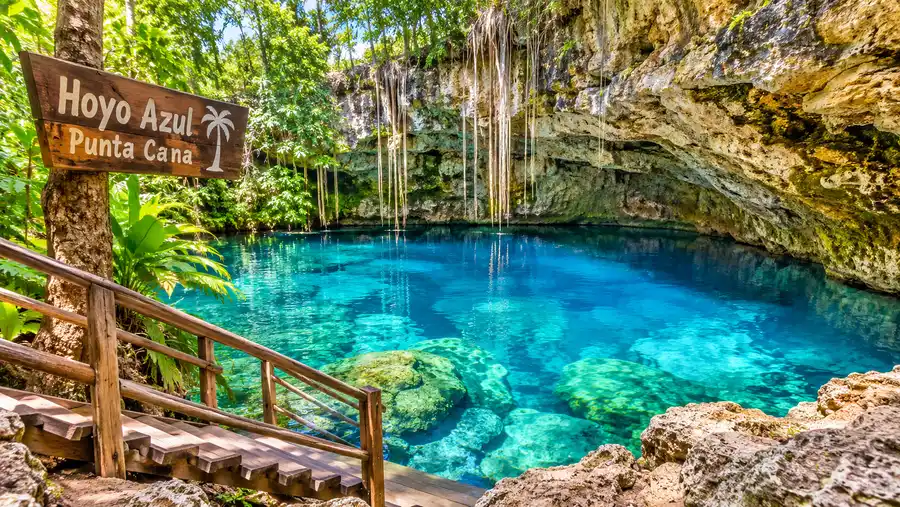
While the swimming area itself feels wide open to the sky on one side, it is framed by the massive overhang of the hoyo azul cave punta cana. Standing on the stairs, look up and behind you into the cavern mouth. The rock face is textured with thousands of years of mineral deposits, where dripping water loaded with dissolved calcite has built delicate stone icicles hanging from the roof.
These speleothems grow at a glacial pace, often taking over a century to add a single cubic centimeter of stone. In the shadowed corners of the cavern wall, you can spot smaller swallow nests tucked into crevices, alongside broad-winged bats that sleep tucked away during the brightest hours of the day. The subterranean cavity stretches back farther than swimmers are permitted to go, disappearing into narrow, submerged shafts where scuba cave divers occasionally map the deeper hydrological network.
- Fluted limestone walls: water running down the cliff face for ten thousand years has carved vertical grooves into the stone, resembling cathedral organ pipes.
- Submerged rock benches: massive slabs of rock that fell during the ceiling collapse sit suspended underwater, covered in a fine layer of white mineral dust.
- Micro-ecosystems: tiny blind cave shrimp and micro-crustaceans survive in the darkest recesses of the aquifer, adapted entirely to cold water without light.
- Dripstone columns: in the rear dry chambers, stalactites and stalagmites have met in the middle, forming thick pillars supporting the remaining cave ceiling.
If you want to spend time exploring the wider cave systems in the park rather than just taking a fast swim, check our breakdown of Hoyo Azul & Scape Park Tours, Tickets, and Excursions, which explains which ticket tiers include the deeper cavern walkthroughs.
Book your hoyo azul punta cana experience:
Water Chemistry and Why the Hoyo Azul Lake Punta Cana Looks Neon Blue
Almost everyone assumes the photographs they see online have been edited to death. Search for hoyo azul punta cana pictures or watch footage on hoyo azul punta cana youtube channels, and the water looks like artificial blue sports drink poured into a rock bowl. I thought it was heavy color grading before I saw it with my own eyes. It turns out the science behind that color is far more fascinating than a photo filter.
The intense azure shade of the hoyo azul lake punta cana comes down to a optical principle known as Rayleigh scattering. When bright sunlight strikes the surface of the pool, water molecules naturally absorb the longer wavelengths of light - the reds, oranges, and yellows. The shorter wavelengths, specifically the blue and violet spectrum, bounce off the pure water molecules and the tiny suspended particles of calcium carbonate floating in the basin. Those scattered blue rays are what reflect back to your camera lens.
Pro tip: Visit between 11:30 AM and 1:30 PM on a cloudless day. This is the narrow window when the sun climbs high enough to crest the sheer eastern cliff, throwing direct vertical light straight down to the 46-foot bottom and igniting the neon glow.
Another factor keeping the hoyo azul lagoon punta cana so clean is the near-total absence of algae. The water is oligotrophic, meaning it contains almost no nitrogen or phosphorus to feed plant life. Without sunlight penetrating deep into the subterranean feed tunnels and without rotting organic matter polluting the basin, green algae cannot establish a foothold. The water remains clinical, transparent, and electric blue year after year.
Planning the travel logistics to get out here from your resort can be slightly tricky if you avoid organized tour buses. We put together a complete guide on How to Get to Hoyo Azul Punta Cana: Location, Map, and Transport, which covers taxi fares, rental car routes, and the exact turn-offs along the highway.
From Hidden Spring to Scape Park: Photos, Legends, and Reality
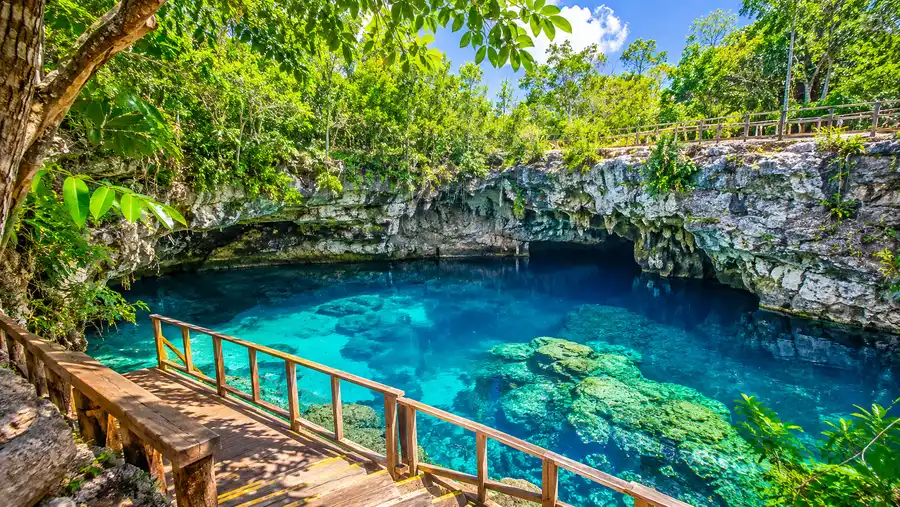
The transition of this wild sinkhole into an international tourism anchor happened fast. Thirty years ago, only local residents and field biologists studied the hoyo azul cenote punta cana. When the Cap Cana tourism project developed thousands of acres along the southern coast, developers realized they had an absolute natural masterpiece sitting against the cliffs. They built Scape Park around it, adding boardwalks, suspension bridges, botanical walkways, and floating docks.
Some purists lament that the wild, untamed nature of the site has been tamed by safety railings and gift shops. It is true that you will not have an isolated Indiana Jones moment here during peak hours. Yet the infrastructure keeps hundreds of people every day from trampling the sensitive native plants on the cliff edge. It also keeps sunscreen residues from destroying the fragile aquatic chemistry, thanks to mandatory outdoor showers stationed along the trail.
- Shower before jumping in: oils, lotions, and sunscreens coat the water surface and choke the micro-organisms living in the subterranean spring.
- Bring water shoes: the wooden planks get slick from dripping swimmers, and the rocks near the steps are rough enough to scrape bare feet.
- Skip heavy dry bags: lockers are available near the park entrance, and lugging large backpacks down the 120-meter trail of stairs is an unnecessary workout.
- Expect a brisk entry: the pool feels cold for about ninety seconds until your skin acclimates, so force yourself to drop in all at once rather than inching down the ladder.
Knowing that this hoyo azul natural pool at punta cana is essentially an open window into a hidden geological plumbing system changes how you experience it. You are not just swimming in a pretty pond. You are floating on top of a 46-foot water column that took millions of years of reef growth, tectonic pushing, and acid carving to create.
Frequently Asked Questions about how deep is hoyo azul punta cana
What is the maximum depth of Hoyo Azul?
The deepest section of the pool reaches approximately 14 meters, which equals roughly 46 feet. The bottom is uneven, with large fallen limestone boulders creating shallower plateaus around 10 to 15 feet near the edges.
Can you touch the bottom of Hoyo Azul while swimming?
No, you cannot touch the bottom anywhere in the main swimming area unless you are a trained free diver. Because the water is so clear, the limestone floor looks only a few feet away, but you will quickly find yourself treading water over deep drop-offs.
Are life jackets required at Hoyo Azul?
Yes, all visitors are required to wear a life vest before entering the pool. The deep water offers very few natural handholds, and the fresh water provides less buoyancy than sea water, making vests an essential safety rule enforced by staff.
Quick Reference
- Max depth: 14 meters (46 feet)
- Water temp: 68°F to 72°F
- Location: Scape Park, Cap Cana
- Formation: Collapsed karst cenote
- Life jacket: Mandatory for all swimmers
Book your hoyo azul punta cana experience:
Before You Take the Plunge
Standing back on the trail, watching light refract across the limestone rock, it is easy to see why this spot captivates everyone who steps foot in Cap Cana. Put down your phone for at least ten minutes while you are in the water. Look up at the immense, ancient cliff hanging over your head, feel the cool subterranean flow rising from 46 feet below, and let yourself appreciate the raw geological history sitting right under your feet.
Read more about hoyo azul punta cana.